Post-Sortie Debrief Process
Debrief Preparation
Ensure that the following actions are completed prior to asembling the team for debrief:
-
Crew Log Export: Export and format digital crew logs in preparation for reconstruction
- Follow 262COS-COMM-SOP-001 for procedures
- Prepare the MIP to project the Windows VM on an external display - Excel should be used to review the Crew Logs
- Sort/Filter the Crew Logs for just events for the current sortie
-
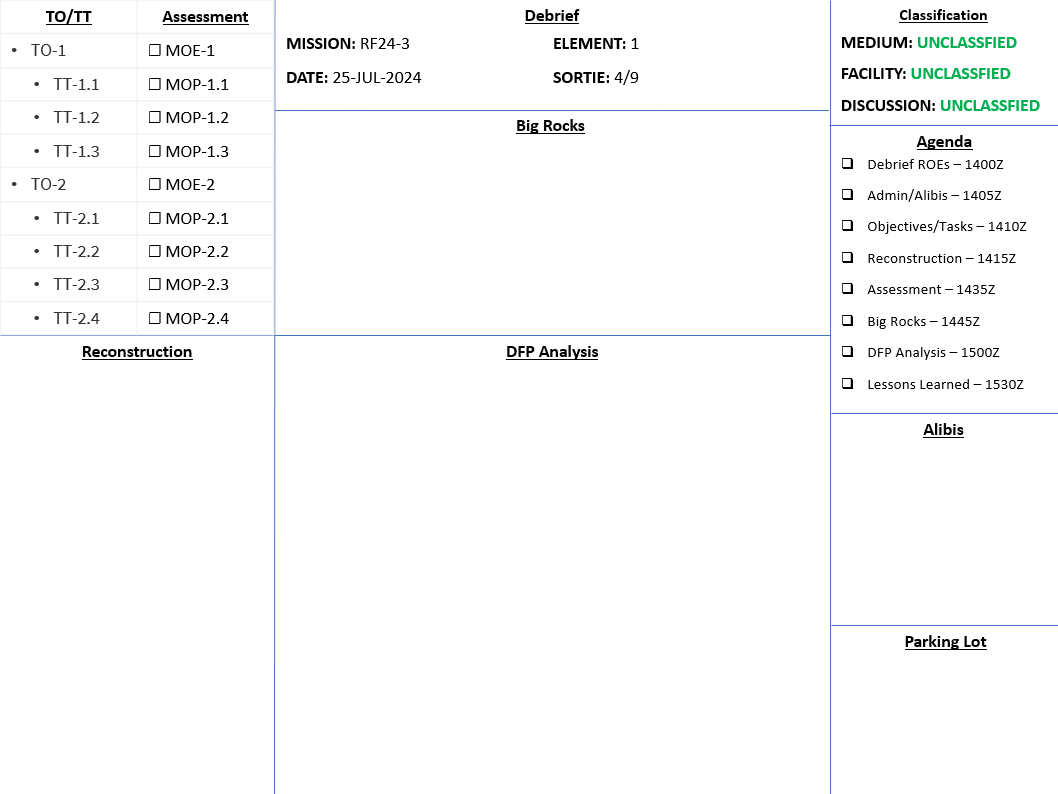
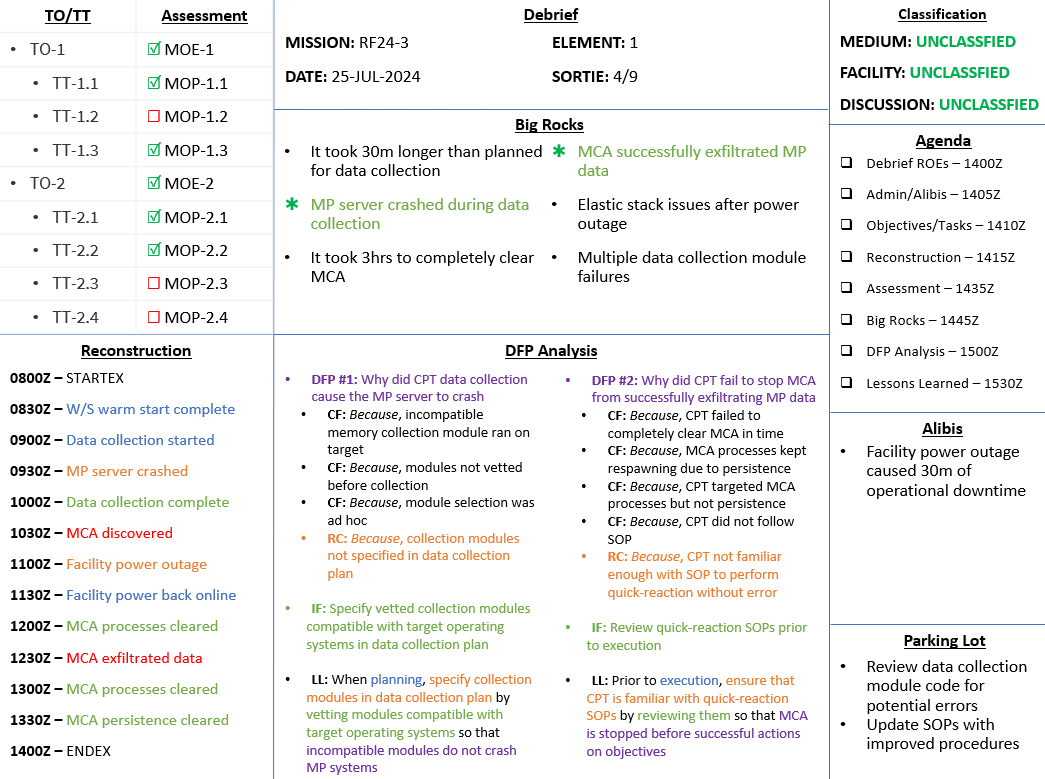
Debrief Medium: Prepare a whiteboard or digital medium that can be viewed by the entire team, and ensure you allocate room for the following elements at a minimum:
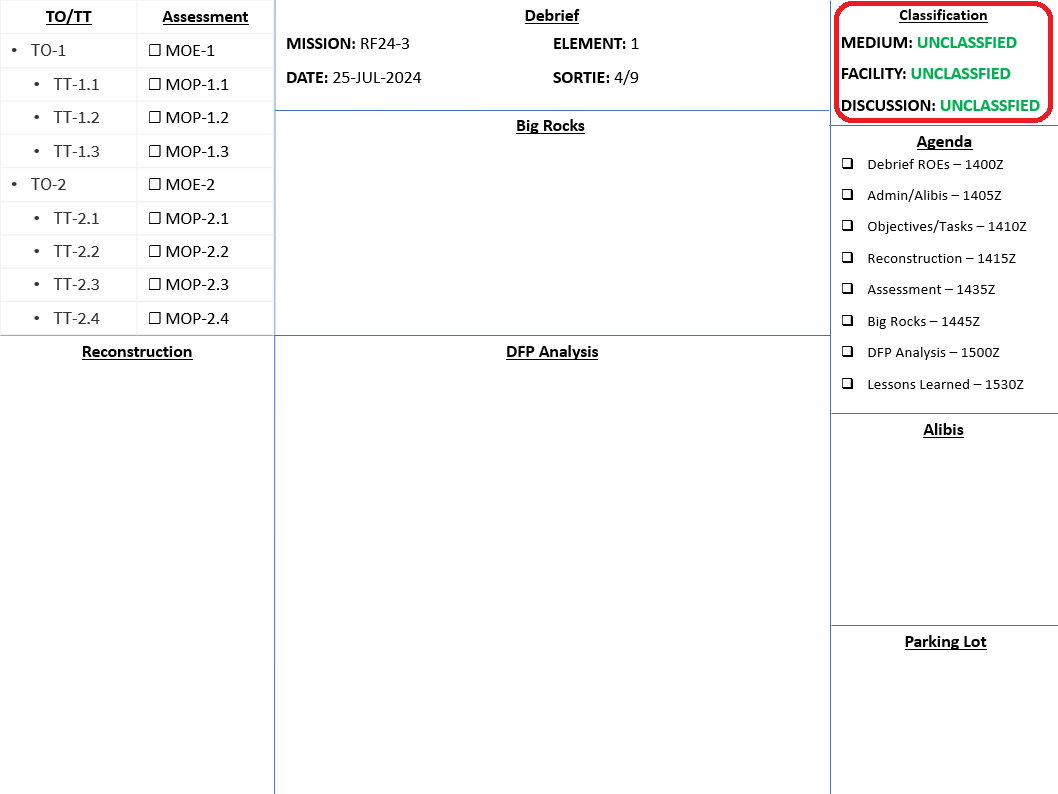
- Classfication: A visible reminder to the team on what can be discussed or written
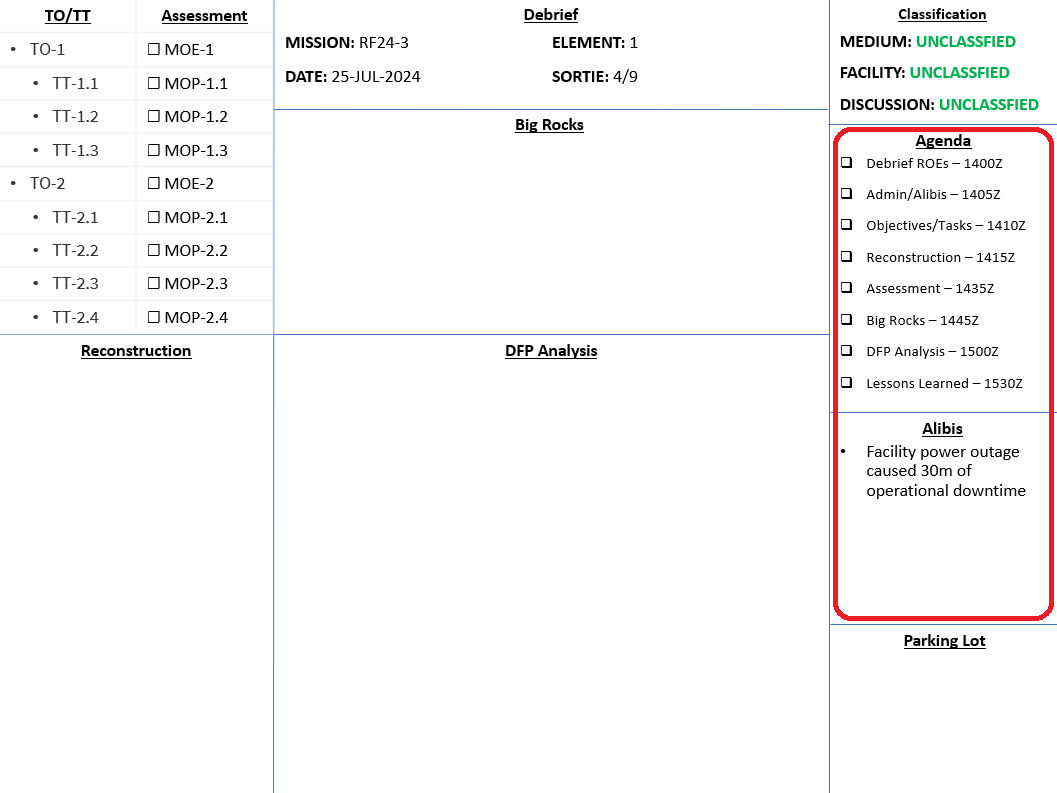
- Agenda: The phases of the debrief and time allocations
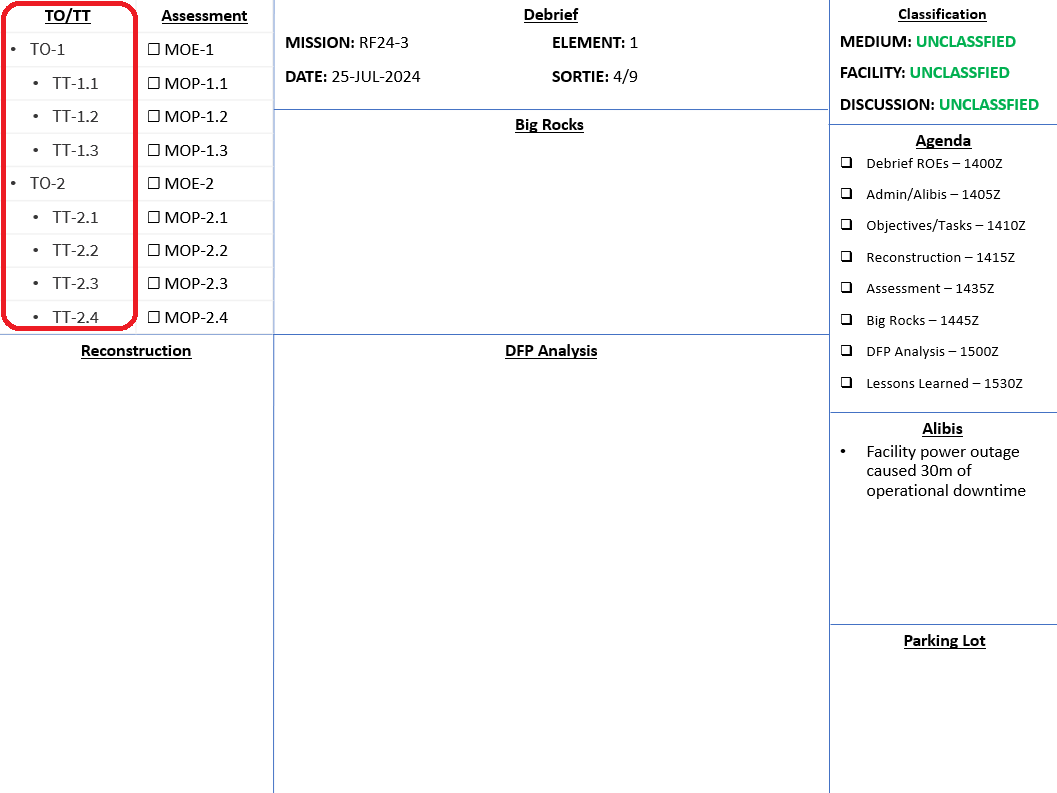
- Objectives: The TOs/TTs assigned for the particular sortie - for brevity you can just annotate the TO/TT # (ex:
TO-1,TT-2.6) - Assessment: The assesment criteria for the TOs/TTs assigned for the particular sortie - for brevity you can just annotate the MOE/MOP # (ex:
MOE-1,MOP-2.6) - Big Rocks: This area should be left blank until the appropriate phase
- DFP Analysis: This area should be left blank until the appropriate phase
- Reconstruction: To save time, this area can be pre-filled with some signifcant events such as STARTEX and ENDEX
| Example Whiteboard (Blank) | Example Whiteboard (Filled) |
|---|---|
 |  |
Debrief Process
1. Classification
Example Whiteboard
-
Prior to any information handling, inform the team of the following:
- The highest debrief medium (whiteboard/computer) classificaiton
- The highest facility storage classification
- The highest discussion classification
2. Debrief ROEs
Debrief Rules of Engagement (ROEs) set clear guidelines and expectations for how the debrief will be conducted. This step establishes a professional and structured environment, ensuring all participants understand the purpose, process, and standards for the session.
-
Review the following Debrief Rules of Engagement (ROEs) with the team:
- Confidentiality: Reinforce that discussions within the debrief are confidential and aimed solely at improving performance, not assigning blame
- Openness and Honesty: Encourage honest feedback and admitting errors without fear of repercussions, to create a safe space for learning
- Focus on Facts: Emphasize that the debrief is data-driven and based on observable actions and outcomes, avoiding subjective opinions
- Respect and Professionalism: Maintain respectful interactions and focus on constructive feedback
- Adherence to Debrief Objectives: Ensure all comments and insights are relevant to the mission's objectives, learning points, and DFPs
3. Admin/Alibis
Admin/Alibis address logistical and administrative details, along with any external factors (or "alibis") that could have influenced mission performance. This ensures all participants are on the same page and contextualizes the upcoming discussion.
Example Whiteboard
-
Admin: Cover any essential information that might affect the debrief, such as the debrief timeline and time constraints, location logistics, or personnel availability, as well as housekeeping actions:
- Ensure that all pre-debrief actions are complete:
- Roll-call - all sortie crew members are present for debrief
- The debrief medium (whiteboard/computer) has been prepared for debrief
- The Crew Log has been exported and formatted for Reconstruction
- Go over the agenda and timeline for each phase of the debrief
- At the end of debrief, ensure that all DFP and LL data is recorded and submitted to 262COS/DOK
- Preferably submit LLs via the SharePoint LL database at https://usaf.dps.mil/teams/262COSDOK/Lists/Lessons%20Learned
- Ensure that all pre-debrief actions are complete:
-
Alibis: Annotate any events or conditions that negatively impacted mission execution that were outisde of the team's control - these are not excuses but factors to account for in understanding mission outcomes accurately:
noteRefer to your Alibis during DFP nomination so that you avoid drilling into a big rock that the team wasn't responsible for causing in the first place
- Real world emergencies, inclement weather, etc.
- Unplanned service interruptions, power outages, etc.
- Weapon system malfunctions, degradations, etc.
- Crew members out sick, etc.
4. Objectives/Tasks
The Objectives/Tasks phase involves reviewing the tactical objectives and tasks that were planned for the sortie, as well as the criteria for success (MOEs/MOPs). This portion sets the context and clarifies the goals the team was working toward. Not all TOs and TTs need to be assessed, just the specific ones that were assigned during the pre-sortie brief.
Example Whiteboard
-
Briefly review all Objectives/Tasks that were planned to be completed during the sortie
-
Annotate any deviations that resulted in unplanned tasks that needed to be completed
5. Reconstruction
The Reconstruction phase involves creating a clear, objective timeline of major events and observations. This phase is essential for identifying discrepancies between the planned and actual execution of the sortie and for setting the foundation for a thorough analysis.
Example Whiteboard
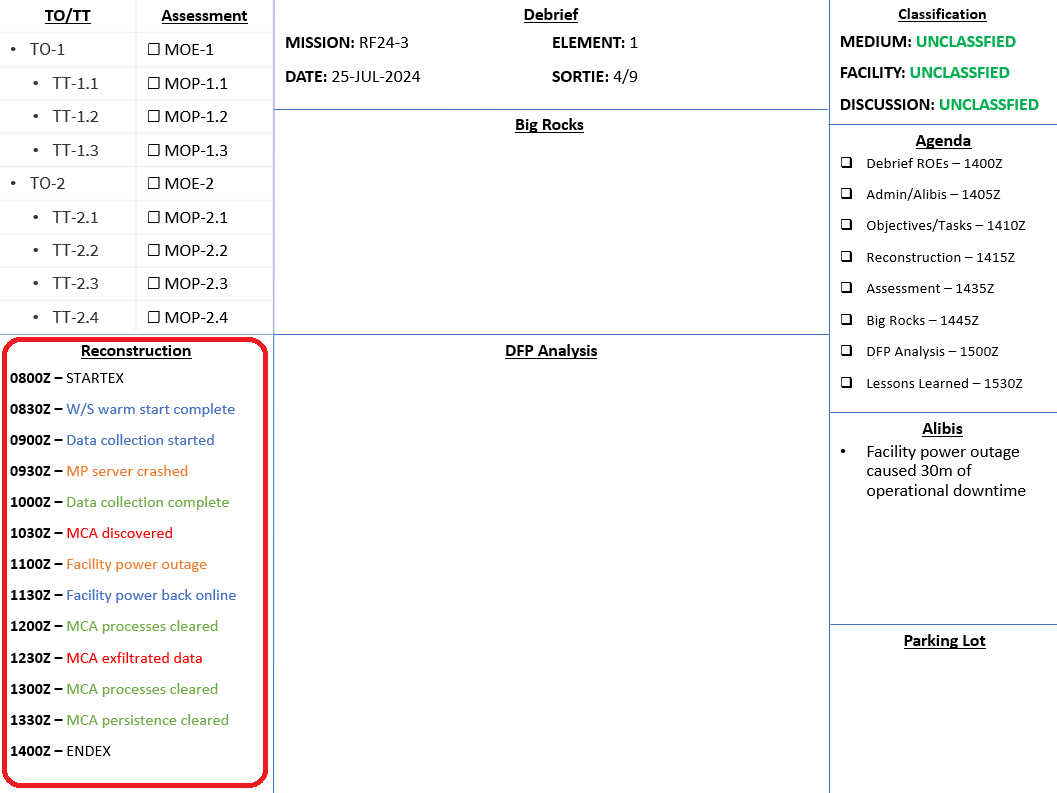
It's best to focus on capturing events and observations that relate to objectives or impacts to the mission, such as:
- Supported mission degradation - timestamps could correlate to CPT or MCA activity
- ROE violations - CPT activity such as enumaration outside of the DAL could attribute to outtages
- Task start/completion times - there may be an observation that a task took too long to complete
- Weapon system changes/malfunctions - degraded capabilities could negatively impact task completion
- Crew member unavailability - unplanned reduction in manpower could negatively impact task completion
- etc.
-
Review the sortie's execution by reconstructing all major events and observations
- Reconstruct the sortie by reviewing the formatted Crew Log export - focusing on highlighted major events
- Strict adherence to communication contracts makes this process easier
- Ensure all members' major observations not captured in the Crew Log are also reviewed as part of the reconstruction
- Identify deviations from the plan
- Reconstruct the sortie by reviewing the formatted Crew Log export - focusing on highlighted major events
6. Assessment
The Assessment phase involves conducting an objective review of what actually happened during the mission. This includes comparing planned vs. actual outcomes and identifying where successes and shortfalls occurred. Use MOEs/MOPs as the measure of success - Did MOP happen? If not, then TT was not completed successfully.
Example Whiteboard
-
Assess Tactical Objective and Tactical Task completion relevant to the sortie - did we actually do what we planned to do?
- Each TT assignee must briefly speak to whether the assigned task was completed or not
- Refer to the TT's MOP(s) on whether the TT was completed as intended
- Planned TTs that had no assignee = a MEL or CL failure that is a big rock in itself
- Assess the accomplishement of each TO planned to be achieved by the end of the sortie
- Refer to the TO's MOE on whether the effect was successfully achieved
- Remember, not all TTs corresponding to a TO need to have been completed in order to generate the desired effect
- Each TT assignee must briefly speak to whether the assigned task was completed or not
7. Big Rocks
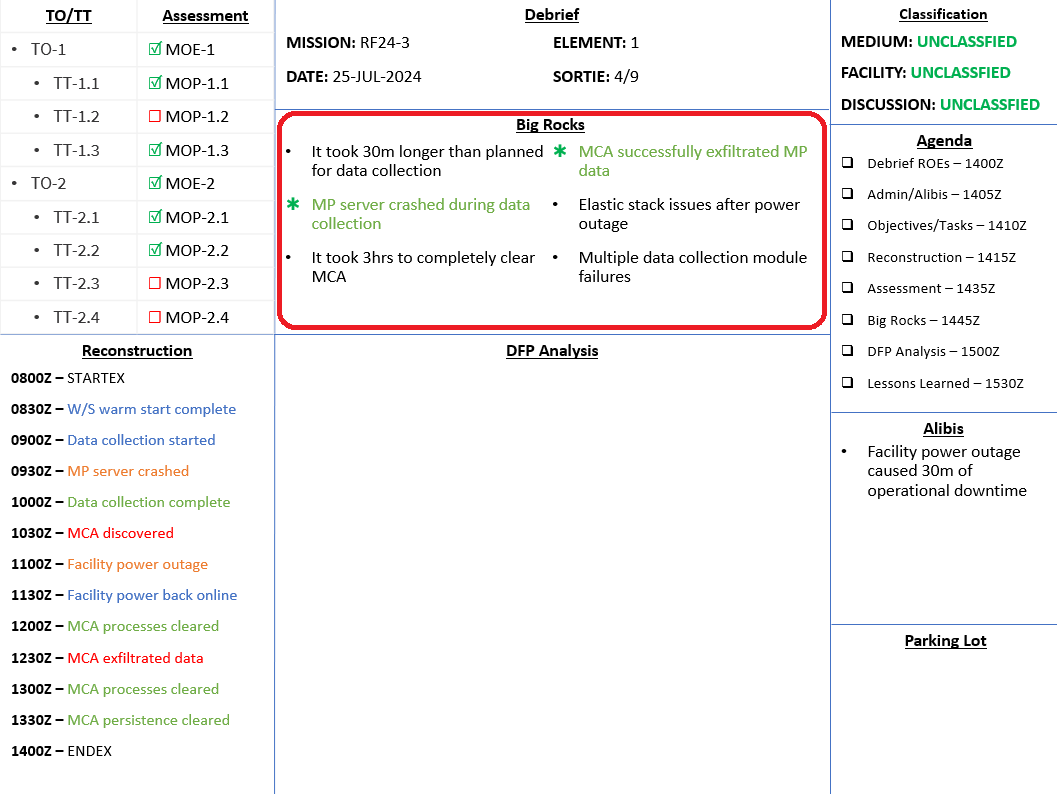
The Big Rocks phase focuses on the most significant events/factors that negatively impacted mission. Big Rocks are major friction points encountered during the mission - correlated to facts - this ensures that the debrief has actionable outcomes that directly feed into improved mission performance.
Example Whiteboard
-
Identify Big Rocks that impeded the mission
- Supported mission failure or degradation - did we do, or fail to do, something that contributed to, or could have prevented, the degradation or failure of our supported mission?
- Incomplete tasks - were there tasks that went unassigned, or could not be completed?
- Phasing/Timing failures - were there tasks that took too long to complete, or started too late?
- Communication failures - did someone never recieve information required to complete a task?
- Unplanned deviations - were there unplanned tasks that we had to figure out and complete on the fly?
- Procedural failures - were there errors in our procedures, resulting in degraded task completion?
- ORM failures - were there identified risks that manifested into problems, but not documented for acceptance or mitigation?
-
Select the highest priority Big Rocks to be promoted to Debrief Focal Points (DFPs)
noteRemember that you must select Big Rocks that had the biggest negative impact to the accomplishement or effectiveness of TOs, or negative impacts to the supported mission. Avoid selecting Big Rocks that the team had no control over, otherwise you will not be able to attribute a Root Cause that is within the team's control to fix.
8. DFP Analysis
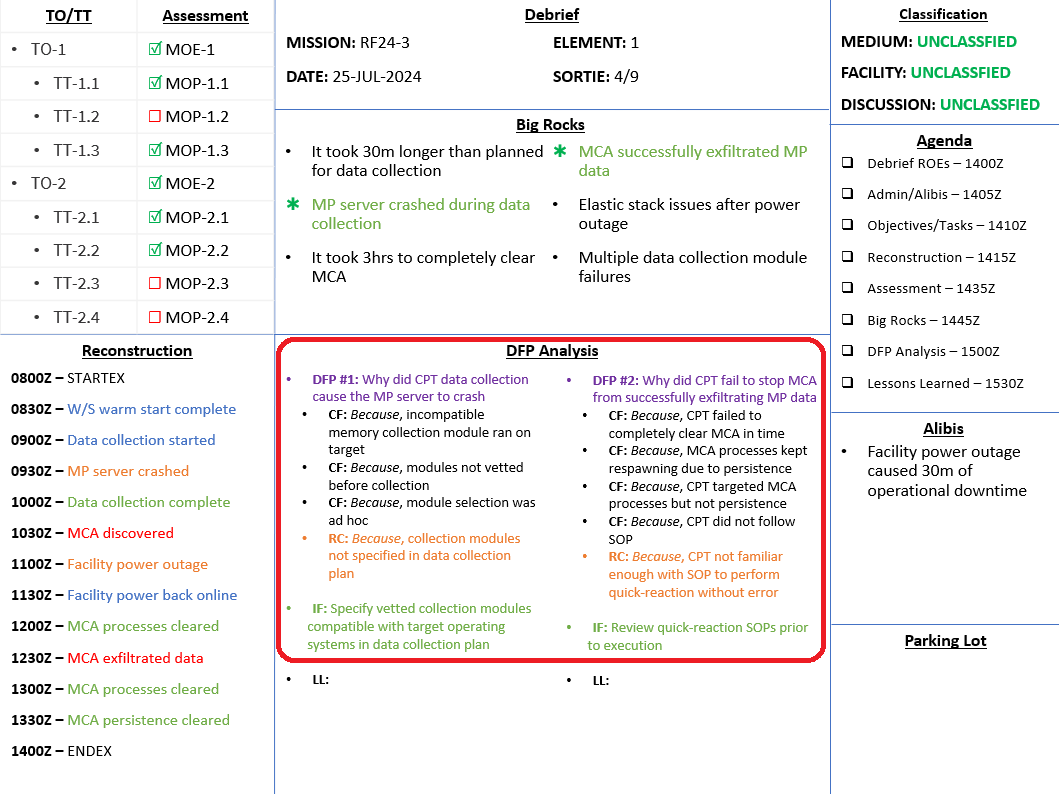
To "walk down" a Debrief Focal Point (DFP) means to methodically analyze and break down a Big Rock and each Contributing Factor that resulted in it's occurance. The goal is to understand why the DFP occurred, what factors contributed to it, and ulitmately identify the Root Cause.
Example Whiteboard
For sortie level debriefs, avoid DFPs that may have a Root Cause that involve any of the categories listed below - they should be saved for the Post-Mission Debrief, which involves the MPC and includes planning/logistical shortfalls. Remember, DFPs should focus on what was within your team's power to correct - "do the best with what you were given".
- Training Deficiencies
- Capability Limitations
- Manning Limitations
- Equipment Limitations
-
If possible, divide the team into smaller crews of personnel to work the respective DFPs that they were most directly involved with
noteIt is not worthwhile to single-thread the entire team during debrief, as it can be a very time consuming process - devide and conquer.
-
Analyze the Debrief Focal Point (DFP) to identify each Contributing Factor (CF), and the Root Cause (RC)
noteCFs must be inwardly focused- meaning that they were factors within the team's control.
- Start by framing the Big Rock into a question to form the DFP
- Tie in the greater operational impact that it caused as well as the team's involvment
- DFP = Big Rock rephrased into an operational question
- Next, try to answer the DFP with a direct and logical answer based on facts to identify the first CF
- Why DFP? Because CF
- Do not make logical leaps
- Repeat the process of answering the CF with a direct answer to identify the next CF
- Why CF? Because CF
- Again, do not make logical leaps
- Once you have landed on a CF that has no viable answer, you have found the RC
- The RC is the CF where the answer would sound less logical and more like "I felt..." or "I thought..."
Example DFP Anlaysis:
- DFP: Why did the CPT fail to stop MCA from successfully exfiltrating MP data
  - CF: Because, CPT failed to completely clear MCA in time
    - CF: Because, MCA processes kept respawning due to persistence
      - CF: Because, CPT targeted MCA processes but not persistence
        - CF: Because, CPT did not follow SOP
          ★ RC: Because, CPT not familiar enough with SOP to perform quick-reaction without error
X CF: Because, CPT thought clear tasks would be simple enough to not need SOP - Start by framing the Big Rock into a question to form the DFP
-
Develop an Instructional Fix (IF) that will prevent the RC from recurring when implemented
noteRemember - your team identified the problem, so your team developes the fix. If the IF requires time not alloted during debrief to develop, then it must have an assignee and due date so that there is accountability for it getting done and not just lost to the ether.
tipMost IFs fall into one of the following categories:
- Tactical/Sortie Level Improvements: Lessons Learned to be implemented in the next sortie that are specific to your team's mission, but too specific to be applicable to be repeatable by other teams.
- Procedural Improvements: New or improved procedures, derived from either a Lesson Learned or Learning Point.
- Capability Improvements: Improved tooling, derived from fixing errors or adding functionality.
- Communication Enhancements: Improved tooling, derived from fixing errors or adding functionality.
9. Lessons Learned
A Lesson Learned (LL) captures the essence of what went wrong and why - and most importantly how to prevent it. They are documented and shared to prevent repeating mistakes, reinforce effective practices, and guide decision-making in similar future situations. They must address "Who, What, When, How, Why":
- When to enact the LL
- What specific actions to perform
- How to accomplish those actions
- Why to comply with the LL (to avoid the DFP)
- Who is responsible for executing the IF
Example Whiteboard
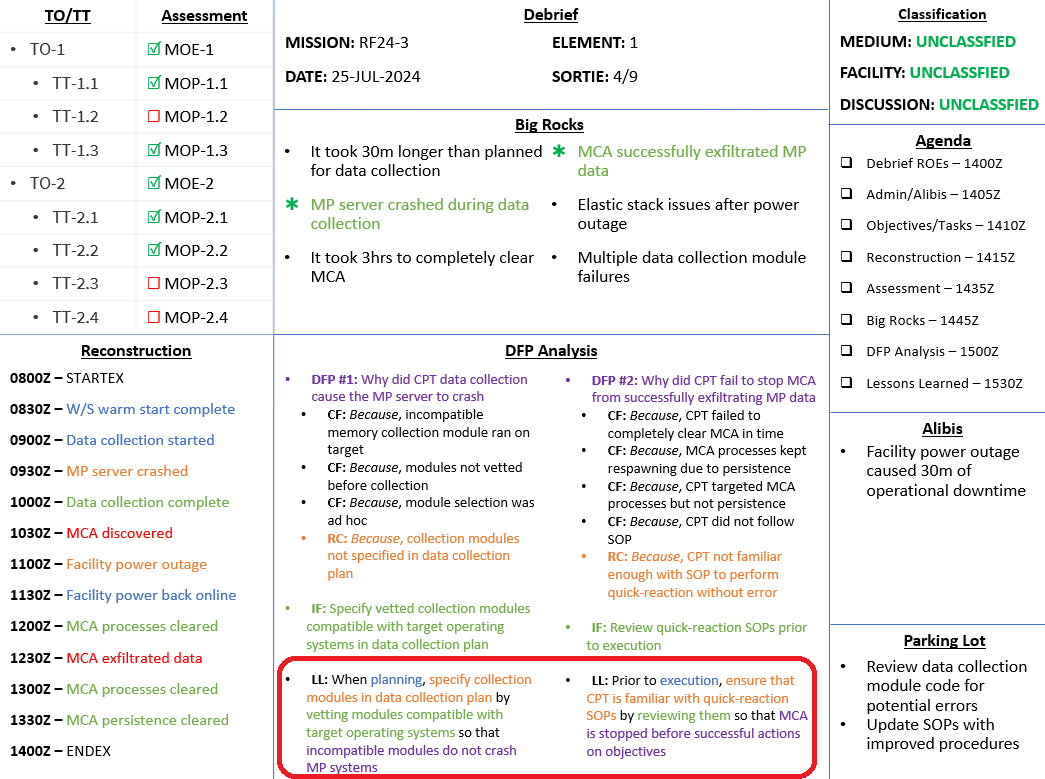
A formal Lesson Learned is written in the following format: When [ACTIVITY], [1/RC] by [IF] so that not [DFP]
Example Verbiage: During execution, the Mission Element Lead will do the opposite of the root cause by performing the instructional fix so that the DFP is avoided
- ACTIVITY: When the implementor needs to implement the Instructional Fix
- 1/RC: Inverse of the Root Cause - try to include who
- IF: The Instructional Fix to implement
- DFP: The Debrief Focal Point - try to condense this to something that makes sense
-
Develop a Lessons Learned for each fully analyzed DFP using the "LL Equation"
-
Present the Lessons Learned to the rest of the team
-
At the end of debrief, ensure that all DFP and LL data is recorded and submitted to 262COS/DOK
- Preferably submit LLs via the SharePoint LL database at https://usaf.dps.mil/teams/262COSDOK/Lists/Lessons%20Learned